
Step 11
Competitive Positioning
Defining your Competitive Position is a quick way to validate your product against your competition, including the customer’s status quo, based on the top two priorities of the Persona.
If you are not in the top right of the resulting chart, you should reevaluate your product. This will also be a very effective vehicle to communicate your qualitative (not quantitative) value proposition to the target customer audience. This keeps you focused on what is most important, creating value for your customer.
Videos
Worksheets
Examples
Content will be published as it becomes available.
Topics
Process Guide
This step spends some time thinking about your competition, but not too much. Often, entrepreneurs spend far too much time on competitors at the expense of focusing on their target customer—especially when they start doing feature-by-feature comparisons with their competitors. Remember, customers don’t care about features; they care about benefits!
You must know the major competitors, especially that incredibly persistent one known as the “do nothing” option, and at some point later on you’ll want to do a more robust analysis of your competition, asking holistic questions like what is the competitor’s strategy, who funds them, who are their key customers, and what are the strengths and weaknesses of the leadership team.
But you’re not there yet! You’re still too early, and there’s a lot that you need to define for your own company first. The Competitive Position is designed to quickly make sure you have fundamentally differentiated yourself from your competition and that your customer sees you are uniquely positioned to create sustainable, superior value for them. If you have properly defined a strong Core, this exercise turns out to be relatively easy.
You’ll use the Competitive Positioning worksheet in conjunction with your primary market research on your Persona’s top priorities. Take the Persona’s top two priorities and put them on the worksheet’s grid, as shown in the diagram below.
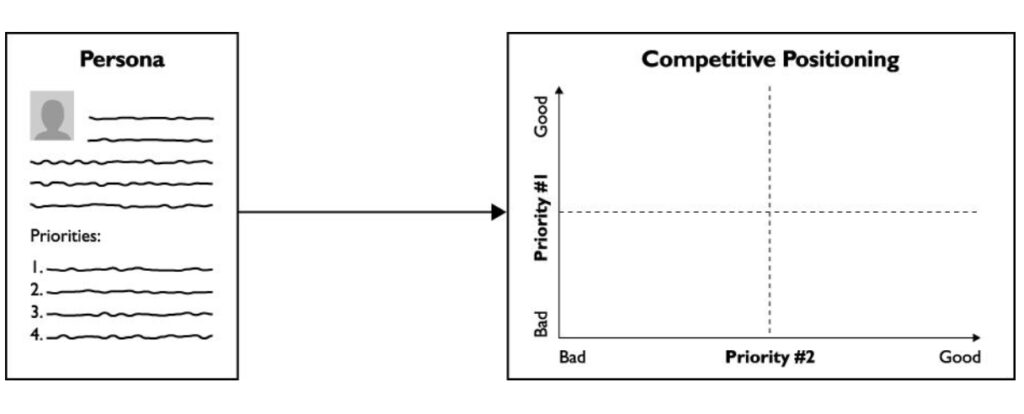 Then plot all the major alternatives the customer has, including the “do nothing” option. Options that are plotted closer to the lower-left corner are bad in all dimensions, whereas options plotted toward the upper-right corner are very attractive.
 Finally, plot your position. Strengthened by your Core and your primary market research-backed work throughout the 24 Steps, you should naturally find yourself in the upper-right corner. If you are not in the upper-right corner, then you should be concerned.
If you are not in the upper right-hand corner, you need to go back and revisit your Core and your market selection. Don’t enter into a long battle you don’t have a game plan to win.
This exercise is really quite simple, which is the benefit and the weakness of this approach as well. It gives you valuable insights to spot problems and gives you a strong general competitive plan, but there is a lot more detail you’ll need once you enter the market. At that point, you will need a much more detailed competitive tactical plan to stay abreast of the competition and win.

Books
Content will be published as it becomes available.
Other Resources
Content will be published as it becomes available.
The Disciplined Entrepreneurship Toolbox
Stay ahead by using the 24 steps together with your team, mentors, and investors.

The books
This methodology with 24 steps and 15 tactics was created at MIT to help you translate your technology or idea into innovative new products. The books were designed for first-time and repeat entrepreneurs so that they can build great ventures.