Step 9
First 10 Customers
This step injects a huge dose of reality into the process in a very constructive way.
Make sure your team is open to the hard work and hard feedback you will get because if done with balance, it will be an invaluable course correction for your team and get you headed in the right direction with a tremendous amount of momentum and confidence. Remember, listening is the willingness to change your mind. Do so intelligently and based on data and real evidence as well as logic.
Videos
Worksheets
Examples
Content will be published as it becomes available.
Topics
Process Guide
The primary market research involved in identifying 10 additional end users and conversing with them about their customer pain will quickly refine and validate or invalidate the work you have done so far.
Start by identifying what you want to gain from talking with additional end users. What hypotheses about your work thus far are you looking to validate during this step? Use the second half of the Lessons Learned worksheet (9.4) to list the main hypotheses you will test before engaging potential customers. Make sure that the conversations you have with end users focus on these hypotheses.
Next, make a list of potential end users to contact. You will need to list more than 10 people since you might not be able to contact or engage with some of the people on your list. Use the List of Potential Contacts worksheet (9.1) to record their information, including where you found out about them (“source”) and, to the best of your knowledge, how closely they match the characteristics of your Persona and End User Profile. You should update this after each conversation.
It is important that you are able to find a truly homogeneous market (i.e., same product, same sales process, and strong word of mouth) in your Next 10 Customers. A common mistake startups make is pretending they have a homogeneous market when they don’t. Don’t delude yourself—be intellectually honest! Don’t settle for the first 10 people whom you can convince to talk to you. You need a homogeneous group of people who are very similar to your Persona.
You also don’t want to talk to people who are not the end user. While the person who decides to buy the product (the economic buyer) is important, as well as key decision makers and influencers, talking to them will not help you solve the end user’s customer pain, and therefore the product you design will not be readily adopted.
As you start to talk with the people on your list, take notes about each contact, using the Notes from Conversation with Potential End User worksheet (9.3) as a guide. Use a new worksheet for each conversation. Pay close attention to the following categories to make sure you have end users who truly match your criteria:
- Demographics
- Psychographics
- Overall Profile
- Full Life Cycle Use Case
- Quantified Value Proposition
At the end of the conversation, if the end-user seems like a good fit, ask if they would be willing to provide a nonbinding letter of intent to purchase the product. As I mentioned above, you are still in inquiry mode, so suddenly asking, “Will you provide a letter of interest or intent?” may well be off-putting. Instead, ask more softly and generally, “If a company were to offer this product, would you make a commitment to purchase it?”
After each conversation, jot down notes about whether the potential end user validated or invalidated any of your hypotheses. Also, think about whether the end user might be a better Persona than your current Persona. There is nothing wrong with changing your Persona! Having an even slightly better Persona in terms of fit and/or accessibility to your team will pay enormous dividends going forward.
Once you have contacted 10 individuals who are good fits for your End User Profile, fill out the Summary of Next 10 Customers worksheet (9.2) with summary information about each person you contacted. You want to make sure that when you put all 10 people in the same table, the information is consistent between them—they all are similar enough that they can be considered part of the same market—and that there was a strong amount of interest in purchasing your product across the board. If either of these two areas is weak, you may need to reassess some fundamental concepts in the work you have done so far.
Finally, complete the Lessons Learned worksheet (9.4) by going back and filling out the first half with an explanation of the process you used to source these potential end users and the conclusions you reached about your hypotheses as a result of your discussions. This table will help you identify which steps you should consider revising. While you should be continually assessing your work at all times during this process, the table will help you clearly identify trouble spots that must be addressed before continuing.
Books
Content will be published as it becomes available.
Other Resources
Content will be published as it becomes available.
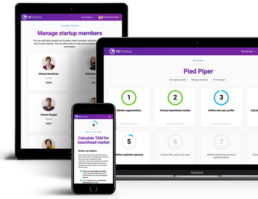
The Disciplined Entrepreneurship Toolbox
Stay ahead by using the 24 steps together with your team, mentors, and investors.
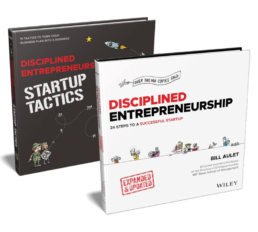
The books
This methodology with 24 steps and 15 tactics was created at MIT to help you translate your technology or idea into innovative new products. The books were designed for first-time and repeat entrepreneurs so that they can build great ventures.