
Step 13
Customer Acquisition Process
Determining the Process to Acquire a Paying Customer defines how the DMU decides to buy the product, and identifies other obstacles that may hinder your ability to sell your product.
While this process may at first seem opaque, confusing, and random, it is not. You need to take a disciplined approach to breaking it down and defining it. Don’t underestimate how important this is and how the sales funnel is the lifeblood of your organization because without continually getting new paying customers, you cease to be an impactful or interesting business. Remember the first commandment: there is no business without paying customers.
Videos
Worksheets
Examples
Content will be published as it becomes available.
Topics
Process Guide
You will build directly off Step 6, Full Life Cycle Use Case; however, there are two major differences. First, you will look at the same process from your perspective (the seller of your new product) as opposed to the customer’s perspective, which was the case in Step 6. The two should be similar and consistent but not exactly the same. Second, this map will link directly to the players in the DMU and the customer’s budgetary process. You will then use that information to develop a first draft of your Sales Funnel, which takes the information from the Full Life Cycle Use Case and turns it into an action plan for your company.
To recap, the key stages from the Full Life Cycle Use Case:
- Determine the need and catalyst for action.
- Find out about options.
- Analyze options.
- Physically acquire the product.
- Pay for the product.
- Install.
- Use and get value.
- Determine value.
- Buy more.
- Tell others about the product.
Some of these stages may be trivial in your situation (especially for business-to-consumer [B2C] sales), but it is still worth thinking about them because even if they are small, they may well trip you up. You may also find that other stages should be included, or the stages should be listed in a different order. For instance, a customer might pay for the product before acquiring it, or after installing it, or somewhere else in the sequence. Feel free to customize the worksheet as needed, but be hesitant to remove any stages without careful thought.
You will start by filling out the Process to Acquire a Paying Customer worksheet with the descriptions of each stage from your Full Life Cycle Use Case as well as information about the acquisition process that you gain from primary market research:
- What does the customer do in this stage?
- Who is involved from the DMU?
- What are the budget limits and other considerations (governmental or company regulations, etc.)?
- How much time will this stage take (give a time range)?
- What is your action plan to accomplish this stage in the most efficient and effective way possible (subject to revision)?
- What are the risks?
- What is your risk mitigation strategy?
- Miscellaneous.
Next, you will convert the Process to Acquire a Paying Customer worksheet into a First Draft Sales Funnel. The Process to Acquire a Paying Customer is mapped out from the customer’s perspective, but to define how your company will sell to the customer, you need to convert that information into a company-focused, step-by-step action plan. You will find in each step that fewer potential customers express interest, but those who are interested are far more likely to buy your product. That is why the process is expressed as a funnel that is wide at the top and narrow at the bottom.
There are many different sales funnel models, and they are all pretty similar but use different words to describe the same process. For instance, the word “lead” has many different definitions depending on whom you ask. Here are the seven elements I will use in describing the sales funnel:
Element #1: Identification—The first element is the “top of the funnel” where you generate leads, people who are potential customers but are not yet aware of your company. You can identify leads through membership lists for groups or associations, through watering holes, and through asking people you’ve spoken with during your primary market research. Once you have compared them to your End User Profile and they are a match, you call them qualified leads. To make things simpler going forward, however, simply refer to leads coming out of this element and the assumption is that they are qualified leads.
Element #2: Consideration—In this element, the lead first becomes aware that they have a problem that needs solving, and second that your product exists to solve that problem. They may develop this awareness through responding to your advertisements by contacting you, or you may initiate the first contact and they express some level of interest in your product. Once the leads have this awareness, they become suspects, and the odds of converting them to customers are much higher. Not every qualified lead will become a suspect—the fraction of leads who become suspects is called the yield rate. Each transition from one element to the next in the sales funnel will have its own yield rate.
Element #3: Engagement—In this element, there starts to be meaningful two-way dialogue with the suspect because the suspect shows nontrivial interest in your product. The suspect might express this interest through participating in a demo, submitting a request for proposal, or engaging in a substantive sales call or online interaction. Now, the suspect turns into a prospect.
Element #4: Purchase Intent—In this element, the prospect demonstrates a clear willingness to purchase and starts negotiating to place the order. In B2B, the prospect may discuss drafting a purchase order. In online shopping, the prospect may put your product in their basket but has not yet checked out. They are now a highly qualified prospect.
Element #5: Purchase—This element is the moment of truth when the customer actually issues the purchase order and pays for your product. In online shopping, the highly qualified prospect would check out and provide their credit card information and the credit card provider confirms the transaction. The highly qualified prospect now becomes a customer.
Element #6: Loyalty—In this element, you focus on making sure the customer receives and installs the product, address any support inquiries that arise, and ensure the customer is getting the expected value out of the product. Hopefully, the customer is now a satisfied customer.
Element #7: Advocacy—In this final element, the customer becomes a repeat customer and/or an evangelist for your product. Evangelists won’t just buy more products, they’ll also tell their friends and acquaintances to purchase your product, too.
Books
Content will be published as it becomes available.
Other Resources
Content will be published as it becomes available.
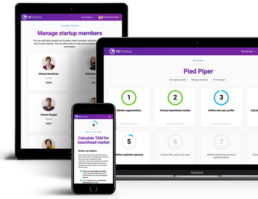
The Disciplined Entrepreneurship Toolbox
Stay ahead by using the 24 steps together with your team, mentors, and investors.
The books
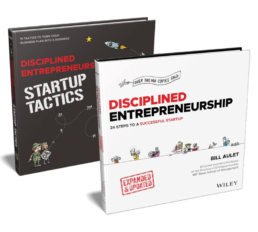
This methodology with 24 steps and 15 tactics was created at MIT to help you translate your technology or idea into innovative new products. The books were designed for first-time and repeat entrepreneurs so that they can build great ventures.