
The Disciplined Entrepreneurship Toolbox
Stay ahead by using the 24 steps together with your team, mentors, and investors.

The books
This methodology with 24 steps and 15 tactics was created at MIT to help you translate your technology or idea into innovative new products. The books were designed for first-time and repeat entrepreneurs so that they can build great ventures.
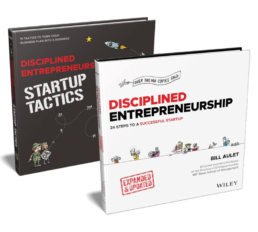
Things change so fast in entrepreneurship that the day you truly believe, the day you have truly figured it out, and stop listening to others, is the day you start to become irrelevant.
That’s why I sent my esteemed colleague at MIT Sloan, John Hauser, a chapter from the Expanded and Updated Disciplined Entrepreneurship book. I wasn’t looking for a pat on the back. I was looking for the truth. And John delivered the kind of feedback that makes you take things to a whole other level.
First, I should introduce John. He is the Kirin Professor of Marketing and Head of the Marketing Group at the MIT Sloan School of Management. He is one of the founders of the field of Marketing Science and was Editor-in-Chief of the academic journal Marketing Science from 1989 to 1995. He is a living legend.
The chapter I sent over was on Primary Market Research. I thought it was pretty solid. John thought it was “extremely well written and valuable for entrepreneurs.” Great start. Then came the real value: six specific suggestions that fundamentally shifted how I think about customer research.
This is what happens when you work with world-class colleagues. You think you know something, and then someone shows you the blind spots.
Warning, this might sound a bit academic, but it is well worth reading.
The Transcript Revolution
First up: recording interviews and using transcripts. Most entrepreneurs I work with are still scribbling notes like they’re back in college. That’s how I do it. John’s point was significant: respondents rarely object to being recorded (in Massachusetts, you just need to ask for permission), and the advantages are massive.
When you’re conducting a customer interview, you’re already doing mental gymnastics. You’re listening, probing, watching body language, steering the conversation without leading the witness. Add frantic notetaking to that cognitive load and something’s going to give, usually the quality of the interview itself.
Even when you record and transcribe, anyone reading those transcripts will miss about half the opportunities buried in there. That’s why he encourages at least two people to read every transcript. And today’s software, including Zoom, produces excellent transcripts automatically.
But that is not all. There are structured ways to uncover customer needs from transcripts. This isn’t just about capturing what was said; it’s about systematically mining those conversations for insights that even the interviewer might have missed in the moment.
Experiential Interviews Beat Focus Groups
His next point was on a topic that I agree with him but he expressed it so much more forcefully. It was regarding focus groups. Too often, entrepreneurs love the idea of getting a bunch of potential customers in a room for instant insights. Except it doesn’t work that way.
John’s argument is elegant and data-driven. An Experiential Interview (EI) is about experiencing the experience of the customer. But here’s the math that drove the point home powerfully: two 30-minute EIs give you as much insight as one 60-minute focus group. But EIs are radically easier to execute. You can do them at the customer’s place of consumption. They’re easier to schedule. You don’t need special logistics. And most importantly, John can train students to conduct good EIs. Focus groups require serious training because you need to make sure everyone talks, not just the extroverts.
The Learning Curve Is Steep (And That’s OK)
Here’s where John told a story that every entrepreneur needs to hear. He recalled working with entrepreneurs who were debriefed after conducting EIs. They were enthusiastic. They thought they had learned a ton. Then John and his team read the transcripts. The customer rarely spoke. The interviewer had done all the talking, and the customer had simply politely confirmed everything. Textbook confirmation bias was playing out in real time.
The good news? With training, these same entrepreneurs got much better. There’s a learning curve, and it’s steep, but it’s climbable. This matters because too many entrepreneurs give up after their first few customer interviews produce garbage results. They think customer research doesn’t work. Neither is true. Like any skill worth having, it takes practice and coaching.
The Interviewer Guide: Topics, Not Questions
This one hit close to home because I’ve made this mistake myself, and I implicitly recommend it in the chapter. The natural tendency is to write an Interviewer Guide as a series of questions. Seems logical.
John spends considerable time in his 15.821 course rewriting interviewer guides. Why? Because a Q&A format limits the interview to your a priori questions. A good EI should explore new opportunities you hadn’t even thought about yet. Second, a Q&A format is boring for the respondent. People don’t want to be interrogated. They want to talk about things they’re enthusiastic about. A good IG is a list of topics to explore, not a script to follow.
This shift from questions to topics sounds subtle, but it’s transformational. It changes the entire dynamic from extraction to exploration.
Breaking the Ice with Metaphor Elicitation
Some people are natural conversationalists. Most aren’t. That’s why John begins interviews with something called Metaphor Elicitation. These don’t just break the ice. They get customers talking about deep thoughts and feelings they would not otherwise express. This is the kind of technique that separates professional customer research from amateur hour. It’s not enough to just ask people questions. You need to create the conditions for them to share things they didn’t even know they were thinking.
Affinitization: Structure Before Importance
The final suggestion was about what to do when your EIs identify hundreds of customer needs. Most people’s instinct is to immediately start ranking them by importance. John’s take: structure is more valuable than importance rankings for idea generation, and affinitization can be done faster and at lower cost than large-sample surveys.
But here’s the twist: have customers do the affinitization, not your team. Why? Because your team will naturally sort customer needs as they build the product. But customers sort them as they use the product. Those are fundamentally different perspectives.
The Real Takeaway
Here’s what I want every entrepreneur reading this to understand: customer research is not a checkbox exercise. It’s a disciplined process that requires training, practice, and constant refinement. John’s feedback reminded me that even when you think you know something well enough to write a chapter about it, there’s always another level of depth to explore. Always someone who can show you the nuances you missed.
That’s why I asked John to read the chapter. Not because I needed validation, but because I needed to be challenged. I needed someone who has spent decades mastering customer research to tell me where my blind spots were. And he did, with six suggestions that transformed not just the chapter, but how I think about listening to customers.
If you take away one thing from this post, let it be this: find your own John Hausers. Find the people who will give you tough, specific, actionable feedback. Don’t just collect cheerleaders; collect truth-tellers. That’s how you get better. That’s how your work gets better. That’s how entrepreneurship as a discipline gets better.
And maybe, just maybe, record your next customer interview and have two people read the transcript. You’ll be amazed at what you discover.

Wow! I already admire your book and the depth of the “recommendations”, but continuously checking back on the latest insights is just awesome and says a lot about the value of your book! A lot of people are venturing in creating a business – especially with AI builders and are wondering why they do not get any traction. Everyone needs to read your book before building a business!
We all need to be constantly challenged in our lives. The over-reliance on personal bias confirming technology has a lot to answer for.
Hi Bill, Two thoughts.
1) Love the concept of automated transcription, but the technology isn’t quite there yet. Everything I’m going to is getting recorded and summarized by AI and I’m still finding too many times that it misses things like the critical negation word. No doubt, tech will get to the performance metrics we want for this skill, but for now we still have to check and double check.
2) On balancing the time between talking & listening – I’m seeing that my tech native students can track time in their heads (thank you 1 minute videos) in ways that took us a lot of practice to learn. So they are much more able to follow an explicit suggestion about who should talk what % of the time.