
The Disciplined Entrepreneurship Toolbox
Stay ahead by using the 24 steps together with your team, mentors, and investors.

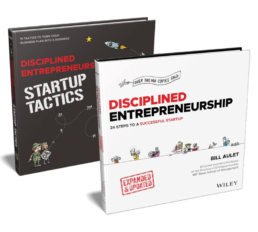
The books
This methodology with 24 steps and 15 tactics was created at MIT to help you translate your technology or idea into innovative new products. The books were designed for first-time and repeat entrepreneurs so that they can build great ventures.
A new DE Book?! Yes, to add the special considerations for a critical area for entrepreneurship—climate and energy.
When you thought I was gone, I am back with another DE book, co-authored by my colleagues at MIT, built on over a decade of work! This sounds like just what the world needs, another book on entrepreneurship?!?!?!? Well, actually, there is a very good reason.
This book provides significant value to a specific group of entrepreneurs because the OG DE book deals with general first principles of entrepreneurship, but then there are substantial additional considerations for deep tech entrepreneurs, particularly in the Climate and Energy space. This space is not just significant economically, but from a societal perspective, it is arguably the moral imperative of our generation. As such, anything we can do to help this group of bold entrepreneurs become more successful is of extremely high importance.

What are some of those differences, you might ask, and I have some examples.
- For instance, what do you do when your end product is a low-margin commodity and there is nothing you can do about it? At the end of the day, energy comes down to an undifferentiated unit called “joules”.
- What do you do when to be successful, you have to scale your company? Well, that is a lot different when in this area as compared to having an enterprise software or consumer technology company.
- What do you do when you can’t just be lean to launch? That is not an option when not only is it a capital-intensive business, but it will probably take decades to achieve significant market penetration. In fact, you are going to have a raise a ton of money to be able to “play in this game of poker”? The financing is much more complicated than just bootstrapping and selling some stock (i.e., equity financing). You have to be much more sophisticated. What do you do when you cannot disintermediate the entrenched players because circumventing the grid or the network of oil pipelines or building factories is not feasible? It is simply not an option. You have to be much more sophisticated and work with and through them.
- What do you do when the customer demands reliability and low cost, and to achieve this, there are extensive and extremely complicated supply chains? You have to take your entrepreneurship skills to the next level.
- What do you do when, no matter what you might wish, there will be regulatory and political considerations involved because people consider access to energy a right, and it is potentially a life-threatening situation? What if there are crucial national security considerations?
Dang, my head is about to explode, and yours should be too.
Energy and climate entrepreneurship is super hard, but as I mentioned above, it is also arguably the moral imperative of our generation. If the earth is burning up and unlivable, not many of the other businesses we build will really matter.
But what can we do? If only there were a guide to help us.
Where there is!!! That is why there is a new DE book.
Available to order right now is the new “DE for Climate and Energy Ventures”. It is in the same format of the DE books you have come to value – easy to read, fun, accessible but also simultaneously providing the reader with systematic and rigorous step by step guidance on how to keep making progress every day… and like the previous versions, it is based on over a decade of iteration at MIT in the class room to create a proven framework to dramatically increase your odds of success and guide you at any step of the process.
So, what are you waiting for? Order now and order for your friends as a great holiday gift, and let’s make this a better world, a better place, while making great companies. The power of disciplined entrepreneurship!
Visit www.DE4CEV.com for more information on the book, or order it here.
You can also read below the forward I wrote for the book, which sets the context:
Foreword
On May 6, 2005, MIT President Susan Hockfield announced in her inauguration speech that climate was the moral imperative of our generation.1 She was going to marshal the vast resources of MIT to address this challenge. One of those assets was our excellence in entrepreneurship.
After decades as an entrepreneur in the information technology (IT) sector, I was surprised by the lack of entrepreneurial activity in the energy sector. Irrationally overconfident (a trait of many entrepreneurs), I thought this was going to be easy. I would just take the refined principles I had learned and apply them to the energy sector, and we would have this sorted out within a year. So, I set out to do my first solo, brand-new-from-the-ground-up course at MIT in the fall of 2007, then called simply “Energy Ventures.”
Oh, was I wrong!
After a systematic analysis of the industry and the challenge, I realized that energy was drastically different. My former MIT colleague and later U.S. Secretary of Energy Ernie Moniz summed up the situation perfectly in just two sentences: “The energy industry is a multi-trillion dollar per year, highly capitalized, commodity business, with exquisite supply chains, providing essential services at all levels of society. This leads to a system with considerable inertia, aversion to risk, extensive regulation, and complex politics.”
The dynamics driving exponential innovation in this sector are different than those in software technology. The end product is often a commodity (such as a kilowatt-hour of electricity), and the industry is extremely capital-intensive. It takes decades for breakthrough innovations to be adopted in the market. Disintermediating the existing players is often not a feasible strategy; you have to work through them. Solutions needed to focus more on price than value, and they definitely need to scale to be meaningful.
Then, there is the fact that energy is an essential service to society and has very direct links to policy and politics. At the micro level, it is often perceived as a right rather than a privilege, which has ramifications at the macro level. At the government level, energy and climate are two of the strongest factors driving national security and economic well-being. While “energy independence” is a term fraught with issues, it is still a powerful topic for political leaders. There is no escaping regulation.
I realized that traditional venture capital, which is a fit for the IT sector, is ill-suited for energy. I wrote about this in my August and October 2007 articles “What’s Wrong with Energy Investing?” (Parts I and II)3, which I must say, with some humble brag, hold up pretty damn well. I wrote them around the peak of Cleantech 1.0 investing. VC investors did not do well at that time, but there were plenty of investors who made money scaling wind power. Unfortunately, many VCs ran away from energy and blamed the sector, not the framework in which they were analyzing and building companies.
But the important question I faced while designing an academic course is: What should the future climate and energy entrepreneur do to be successful? After a tremendous amount of thought and testing hypotheses, I realized, along with my colleague (and course co-founder) Tod Hynes, that there are key components of the battle-tested Disciplined Entrepreneurship framework that easily transfer.
Our course has run continuously since its 2007 launch. Well over 600 students have taken it, and we have seen how they have done in the real world. Our teaching team expanded to include Frankie O’Sullivan, who brought an incredible depth of expertise on the technical side to the team; Libby Wayman, who adds expertise based on her firsthand experience in government and large corporations; Jacqulyn Pless, who joined as an instructor and shared her wisdom on economics, policy, and innovation; and finally, Ben Soltoff, who added a new perspective that included rich experience and expertise in climate and being a thoughtful writer (don’t underestimate that when documenting what you are learning and writing a book!). A series of tremendously talented teaching assistants have also helped run the course.
The result is a framework that we have found to work, and we have the evidence to show it. Over 60 companies have directly come out of the class, and they have raised at least $2.3 billion in funding and created more than 2,500 jobs. There have also been at least 116 CEOs and co-founders who have come through the course over the years. Several students have gone on to start their second and even third companies. These alumni companies have raised at least $5 billion and created more than 4500 jobs.
Is it an algorithm? Is it perfect? Is it done? The answer to all of these questions is definitely no. It will be forever evolving, but I am sure what we are offering in this book will contribute significantly to the corpus of knowledge about how to teach and do entrepreneurship, or simply call it innovation if you want, because it does not need to be tied to startups in this incredibly important field. In fact, I can think of nowhere else where innovation is more important. We need more innovative leaders in large government, corporate, and non-profit organizations who can run through brick walls to make the change needed for economies to adapt to the changing climate and stop making the problem even worse.
Lastly, as we have seen with the foundational Disciplined Entrepreneurship framework, we can start to apply artificial intelligence and create tools that will even further accelerate our ability to innovate, but first, we must refine the methodology. To write the prompt libraries, you first need a proven framework. That is what we are offering here for the first time.
That is our goal in this book—to share a practical guide for building climate and energy ventures—and I am confident you will find it helpful. We look forward to others building off this to solve the singularly most fundamental challenge of our generation, as President Hockfield laid out over two decades ago now.
Bill Aulet

If you want a video with a leap in it about the book, here it is https://www.linkedin.com/feed/update/urn:li:activity:7397638686458421248/
What ever it takes.