
The Disciplined Entrepreneurship Toolbox
Stay ahead by using the 24 steps together with your team, mentors, and investors.

The books
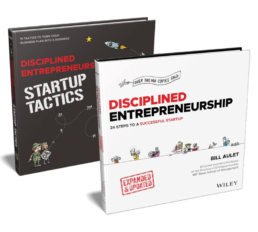
This methodology with 24 steps and 15 tactics was created at MIT to help you translate your technology or idea into innovative new products. The books were designed for first-time and repeat entrepreneurs so that they can build great ventures.
Summer has the perception of a time for relaxing, but the opposite is true for entrepreneurship at MIT. Great companies, and more importantly, great entrepreneurs, are developed in the summer in our delta v program, where the students get to work full time on their ideas with the full support of our staff. This is the time when they make the greatest progress.
Who, you might ask, makes the most progress and has the most success in creating new, scalable, and impactful companies? What are their traits?
While there is no cookie-cutter algorithm and will never be for this, as I reflected this summer with two decades of experience now, I am comfortable identifying 9 major traits that make teams successful. There are exceptions, but the great entrepreneurs and companies that come out of our program share these characteristics:
- Focus on Organization Rather than Product: In our classes, we ask our students, “Are you building a feature, a product, or a company?” A feature is something you will license to someone who has a product. A product is something that you will probably end up selling to a company with a broader vision. The broader vision will be represented by a portfolio of products that serve a customer base. A company is focused on solving customer problems and helping them realize new opportunities. Frederic Kerrest, who founded Okt, always talked about creating an iconic company, and he did! Okta became one of our first decacorns. Don’t get me wrong, he talked about how to make a great product that solved customers’ challenges with regard to cloud computing, but that was a means to an end. Don’t get me wrong, you must develop great products that create unique and meaningful value, but falling in love with your product (or a technology) as opposed to falling in love (and obsessing over) solving a customer problem is one of the most common and limiting mistakes entrepreneurs make. Successful long-term entrepreneurs focus on building a great company, which is a bar higher than just a great product.
- Raison D’Être: There should be a driving mission behind why the team is starting a company that is personal. Why is the world going to be a better place because of this company? And do you really, really care so much about it that you would do it for less money? If it is just about making money, that is mercenary and what I would call “profiteering,” which is not entrepreneurship that is going to sustain through the hard times … and there will be hard times. You would be willing to do what your company is going to do for less money and be damn proud of what you are doing; otherwise, it will not last and grow. Elliot Cohen founded PillPack for personal reasons after watching what his family had to go through with regard to medication. There were many dark days, but what kept him and the team going was the mission, even when there were more profitable job opportunities for him and his team. In the end, it turned out to be a huge financial success, but that was not why they set out to create PillPack, and what kept them going during the tough times.
- Bias to Action: The single necessary and sufficient condition for a business is a paying customer; it is not a business plan. Yes, I am not one of those crazy people who say just build stuff and you don’t need a plan. You need a plan, but it only gets you so far. You need a plan to develop intelligent hypotheses but rapidly test them. At all costs, avoid analysis paralysis. When in doubt, do something. As Marc Randolph, co-founder of Netflix, said in his iconic book That Will Never Work, no matter how long you spend sitting around talking, what you think is true is not, or is at least wildly incomplete in so many ways. You have to develop a plan (which DE helps you with in an efficient and effective manner), but you have to quickly get out into the marketplace and test things with potential customers to get the real truth. The balance between thought and action is a critical component of successful teams.
- Ability to Laugh at Oneself: As mentioned, no matter how smart you are, you will be wrong and miss what you don’t know. So, a critical component of success for entrepreneurs and entrepreneurial teams is to be able to laugh at oneself and admit you were wrong and pivot and then keep going, but even faster and with more conviction. Great entrepreneurs learn from their mistakes. You learn more from failure than success. Don’t take yourself too seriously, or it will kill you, your team, and your company.
- Tough Conversations: The hardest part of new companies is the people aspect. Ask anyone who has ever done one, and they will tell you. Again, no matter how much you try a priori, there will be unknowns about your team that will have to be resolved. There is no team ever that was just a Candyland of blue skies, sunshine, rainbows, butterflies, and unicorns. There will be business disagreements, changing personal situations and requirements, personality conflicts, and equity splitting conversations. Can the team do this in a way that they come out of it stronger? These never end, and the team has to build up the capability to address conflicts and disagreements, or it will be like a whale that keeps getting slowed down by harpoons until it dies.
- Embrace Adversity and Change: Does your organization have the antifragile mindset, skill set, and way of operating to get better from adversity? Adversity should be embraced as making the new venture stronger. An example of this is Dr. Jon Bloom, who founded Podimetrics, talks about how losing a business plan competition and not getting $100K in non-dilutive funding was a devastating blow to his team very early on in its life cycle, but it turned out to be the best thing that could have happened. The $100K was not going to make or break the company (which has gone on to great success), but it was a test of how committed the team was for the long term and to build the confidence to be creative to survive. One of the great things we did at our center was this Antifragile Speaker series, and if you haven’t seen it, I highly recommend it.
- People Want to Help You: This is one that lots of people want to have, but it is hard to attain. It requires deep authenticity and true willingness to be a committed community member, even when it might not seem to be in your interest. We all know these people as they are the ones that we want to help, and they are always there to help us when we need it. Not sure how they do it, but they do. They will hate me calling them out in this regard because they are much more servant leaders but recent cohort members like Bruce Crawford, Mike Sanchez and MJ Antonini are people like this whom staff and the other cohort members and staff just want to help because they always go out of their way to help others, but still find a way to get their own work done. Their plans and commitment levels were like others, but they enjoyed higher levels of success because they had built a true fan base that wanted to help them. Turns out that good deeds can be paid back in multiples if done properly and authentically. Nice people can finish first.
- Love the Game: I will always remember when Nagarjuna Venna showed up at my office five years ago and asked if he could help out at the Trust Center. He had been involved in our programs, but we had lost touch in the intervening years, and I thought he was just looking to get involved to find his next gig or maybe looking for a job at our center. When I found out that he had co-founded the wildly successful BitSight, I was a bit shocked and asked why he was looking to help us out for nothing in return. Shouldn’t he be out playing gold or being a VC now? He looked at me and said simply, “I could, but I love this game too much.” He was doing it just because he loved being around and helping entrepreneurs. There is something beautiful about the process of entrepreneurship that you must embrace. It is messy and incredibly hard. It is frustrating and tests you like nothing else, but is rewarding beyond words when done right. As Remington Hotchkiss said in a video at the end of our one-week fully immersive program at MIT EDP, which makes me cry or at least tear up each time I watch it, said, “There is being alive and there is living.” Entrepreneurship makes one’s life so much more meaningful, so embrace the grind and the pain or the “suck” as some say. Love the game, not just the results. We don’t stop entrepreneuring because we get old, we get old because we stop entrepreneuring.
- Competitive Streak: The great ones also have an underlying constructive competitive streak, too, that stokes the fires to get to another level. Yes, great entrepreneurs are great community members and help out others, but you can also be a competitor seeking to be the best. These two can coexist. Every single one of the examples I have mentioned above has this as well.
These are the top common traits that I have come to see as making for great teams and long-term success. They are not completely discrete and actually overlap, and I could give much more depth on each and examples, but I hope this starts a productive dialogue on how to make better entrepreneurs, because we really need them.