

The Disciplined Entrepreneurship Toolbox
Stay ahead by using the 24 steps together with your team, mentors, and investors.

The books
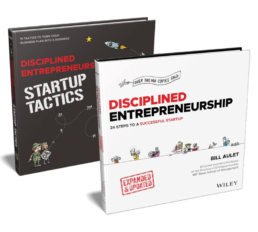
This methodology with 24 steps and 15 tactics was created at MIT to help you translate your technology or idea into innovative new products. The books were designed for first-time and repeat entrepreneurs so that they can build great ventures.
This morning I was forwarded this post by Paul Graham:
“How Universities Should Prepare Founders”.
This is a great post, and I was excited to read it, but it left me with very mixed feelings. Unfortunately, it will be taken as gospel by far too many people. Paul has enormous credibility, and rightly so. YC has been an incredibly successful economic engine and created a new model that we use, in part, to educate students today.
There is much in the post I stand up and cheer for — points we are in violent agreement on and work to implement at MIT every day. Kudos for nailing those. But I came to this differently. I was an entrepreneur by design and fell into academia by accident twenty years ago. What I have learned since is that educational institutions play a very different role, and that role is hard to understand unless you immerse yourself in one.
I would welcome an open debate on this and a melding of the two views. In biology, it is called hybrid vigor; in our field, it is called translational research. Ping me anytime. I love being proven wrong, because it means I am learning something. My goal here is not economic. It is simply to produce more and better mission-driven, innovation-based entrepreneurs who make the world better. No more, no less — and I believe educational institutions are vital to that.
This deserves a rich back-and-forth rather than posts fired past each other, so at the risk of creating a less productive exchange, I’ll offer a few points to whet the appetite.
- A university’s job is not to create companies. It is to create entrepreneurs. Our job is not to catch fish; it is to teach people how to fish.
- Educators will not be the best investors, and investors will not be the best educators. Some don’t like hearing this. Before the knee-jerk response, think through all the incentives deeply. Then sit with them again. System design dictates behavior.
- I doubt YC will exist in 100 years, or possibly even 20. I am absolutely not picking on YC, but rather making the point that it is an extremely small subset of economic organizations, and they are of a different structure; look at the shrinking life expectancy of S&P 500 companies. But MIT will. As such, we can and should play the long game. That is literally our role. That doesn’t diminish YC or any other economic entity — it means we play different positions on the same team.
- Humans are born entrepreneurs. It is in all of us; without it, we would not have survived. “Entrepreneurship by necessity” as a form of entrepreneurship is very real. That doesn’t make us identical — entrepreneurship is a team sport with different roles: the hacker, the hustler, the designer, the organizer, etc. But the industrial revolution, economic prosperity, and arguably our education system have suppressed that instinct rather than drawn it out.
- Entrepreneurship can be taught. Researchers have compelling data, and it is self-evident that more reps, especially with knowledgeable mentorship, make you better. We agree it is not a theoretical exercise like math or physics but a craft requiring apprenticeship. Yet like every craft, it has first principles you can learn and apply to improve your odds. It will never be deterministic. You are doing something that has never been done before. That is the whole point. But you can learn the first principles that significantly improve the odds of success, and they can be taught through an apprenticeship and project-based model, as spelled out.
- Entrepreneurship in academia has been far from perfect. We surely agree there. Consider the precedent. In the 1800s, chemistry and the chemical industry coexisted almost entirely disconnected. Academic chemists were rigorous but rarely relevant to practitioners. Practitioners were relevant but lacked evidentiary rigor and did not really use scientific research methods with the rigor of academia. The incentives, tenure on one side, promotion on the other, rewarded neither in bridging the gap. Then, in 1888, MIT established a new field called chemical engineering, deliberately connecting the two for the first time. Calling it a game changer understates it – and no need to just take my word for it; just ask Claude. That is what we need to establish here.
- Why can’t YC do this alone? The incentives aren’t aligned. YC does its job superbly, but its data set suffers from survivorship bias. If you want the next unicorn, the profile you converge on is one we all recognize. Meanwhile, a huge portion of society — people without the education, exposure, or safety net to take risks — see entrepreneurship as the opposite of security and never participate. And they are probably right unless they receive the proper foundational training and support. YC is neither incentivized nor positioned to reach them. That is the education system’s job. This is what we are attempting and doing better and better today.
- Some of this is definitional. YC says founders; that gets conflated with entrepreneurs. YC is looking for unicorn founders, a subset of what we would call entrepreneurs. Entrepreneurs, as we define it, have a mindset, skill set, and way of operating that lets them build economically sustainable new ventures — high-growth startups, yes, but also non-profits, mission-based organizations, and new ventures inside academia, government, and corporations. We will not solve society’s intractable problems in areas like climate or education without entrepreneurs at every level. Diminishing the importance of raising the bar in universities is, I would argue, unhelpful at the macro level. It is central to reinventing our education system generally, and management education in particular, as we are working to do at MIT now.
- All of this is an invitation to more conversation. Collective wisdom exceeds any one person’s or organization’s when the dialogue is productive. Universities like MIT very much want to work with organizations like YC; we play complementary positions. In fact, a crucial role universities play is providing a (hopefully) unconflicted platform for open and productive discussions like this.
In that spirit, one passage jumped out at me like a bolt of lightning that I want to raise as an example of the dialogue we could have and how we have differing but both valuable perspectives:
The hard part of startups is product: knowing what to build, and being able to build it. And that kind of knowledge comes from studying computer science or mechanical engineering or molecular biology, not management or finance.
Having built companies and worked with thousands of entrepreneurs for over 45 years, I would push back hard on this from our data. We engineers (and I count myself and our institution in this category) would like this to be true, but the data tells us otherwise. When we ask experienced founders what is hardest about building a great company, product is not the most common answer — and less so every year as products and product development are commoditized by AI. Nor is it product-market fit, which is becoming table stakes, as the mechanics of it are now very well known, documented, and practiced.
The hardest part of startups is this carbon-based life form called humans. Give me a good product and a great team, over a great product and a mediocre team, every day of the week and twice on Saturday and Sunday. I cannot recall an experienced entrepreneur disagreeing – but maybe there is some bias in our data set. The research agrees: the best initial product does not always win. Great products sometimes do win on their own — the coefficient is not zero — but if you want the best odds, bet much more on the team. Every product has an expiration date, and in today’s world products themselves can be commodities. What distinguishes success is go-to-market strategy and execution as well, which I don’t see being taught in the departments you mention above.
So let me close where the headline started. I hope people read this insightful Paul Graham post not as the final word on what universities should and should not do in entrepreneurship education, but as one valuable voice in a discussion about how we raise the bar together. The goal is to bring mission-driven, innovation-based entrepreneurship to bear on society’s greatest challenges. That is what we all want, and it is directly aligned with MIT’s mission — and with the mission of every institution of higher learning.

Bill – thank you for the piece. The passage that mattered most was your pushback on product. In my response to Paul’s post I conceded too much. Building the product comes from a discipline, building the company does not, and Paul collapsed them in his essay. My next response will dovetail with your seventh point – students without exposure or a safety net need proximity and not simply evidence – and “free time” isn’t free for students who have to pay their way for rent and tuition.
Fantastic Start! I hope Paul engages on this conversation and you two run several “stress tests”.
If “A university’s job is not to create companies. It is to create entrepreneurs- not to catch fish, but to teach fishing.” AND Entrepreneurs ⊃ Startups ⊃ Innovation Ecosystem ⊃ Economic Prosperity, THEN “leave them alone” and “build the bridge” are not an EITHER/OR proposition.
After a few sessions of iron sharpening iron, I propose a panel in Wyoming. Because it would be a great litmus test for “agglomeration is what matters most,” and that is why “no one builds here” in the countryside.