

Dateline Luxembourg: March 16-18, 2019
On Saturday and Sunday, March 16th and 17th, I had the good fortune to run a two-day seminar on “Introduction to Disciplined Entrepreneurship” at the University of Luxembourg. In the process of this and the following Monday, I had a chance to directly experience what was happening with entrepreneurship in the Grand Duchy of 600,000 inhabitants, or more specifically, in its dominant city, the City of Luxembourg. These types of experiences always generate interesting data points to refine my worldview of entrepreneurship and this was no exception.
First of all, my preconception of Luxembourg being a sort of neutral and non-threatening country that people from many nationalities would mix was actually confirmed. It reminded me of the Dubai of Europe. It is a country of great (but not over the top) wealth. There was a lot of activity and new construction was everywhere. It has the second highest GDP per capita ($125K per year) in the world after Qatar. This is due to a vibrant banking system and the presence of the European Union, which pays extremely well. The question of why the banking system is so vibrant – is it because the Swiss are starting to crack down on anonymous bank accounts and Luxembourg has not? – I will not address nor should I with my expertise, or lack thereof. In any case, there is a lot of wealth around as evidenced by the omnipresent very high-end automobiles. As a side note, it is also very nice to see a strong commitment to making urban transportation be less impactful to the climate. This is demonstrated by the city’s plan to provide free transportation to everyone on the city’s rapidly expanding tram systems. Back to the real topic of this post…
Focusing on the entrepreneurial lessons of Luxembourg, I think there are four major factors that I took away above all the others that are worthy of comment here:
- Heterogeneous population.
- Great wealth but with a low-risk population.
- A new (founded in 2003) university.
- Desire to move from banking to an entrepreneurial driven economy.
With the first three factors can they achieve the fourth?
While I was there for only three days and am no expert on the country, I do have some observations that will hopefully be helpful and stir up some productive dialogue.
- Heterogeneity: This is always a good thing for entrepreneurship and bodes well for entrepreneurship in Luxembourg. Entrepreneurship feeds off different perspectives, skills sets, and networks. This creates communities that thrive from the hybrid vigor resulting from different thoughts, products, and implementation. Even though the program had only approximately 35 participants, in addition to native Luxembourgers, we had representatives in the program across Western Europe, North and South America, the Middle East, Eastern Europe, and Asia. It is truly amazing.
- Commercial Bankers’ Risk Profile: Entrepreneurs often complain that bankers don’t make their vast treasure chests available to them. This, however, is not a bankers role. Their job is to loan against hard assets and when they veer off this path, economies can really suffer, see the American banking meltdown of 2008. As such, entrepreneurs should understand that commercial bankers are risk averse by design. Commercial bankers’ job is not to loan to entrepreneurs who have few or no hard assets. That is the job of risk capital – business angels, venture capital and private equity. Bankers are trained to be risk averse and we want them to be. They are guarding our money after all!
- Risk Reduction – 4 Dimensions: So how can the entrepreneurs get some of the significant amount of money in Luxembourg? There is always plenty of money around to invest but people want to invest in good investments where they can add value and not risky ones. Financial investors of all varieties are willing to invest if they can see the risk reduced in areas they cannot control or effect. Any new venture has four dimensions of risk: technology, market (which includes timing), execution, financial. It is the job of the entrepreneur to demonstrate that she has “de-risked” the first three elements to the potential investor. Then the rational financial investor will be most interested to become a financial participant in the venture. That is the one dimension they can most control, fix and add value.
- #BeDisciplined: Since this is the case and there is plenty of money in Luxembourg, but not much risk capital, entrepreneurs need to respond accordingly. To accelerate the development of this sector it will take two things. First, and most obviously, it takes some success stories, which end with exits. Secondly, and less obvious, it takes the current generation of entrepreneurs to be more disciplined to make these successful exits and make it easier for investors to invest. Being disciplined means showing potential (now timid) investors that the entrepreneurs have dramatically reduced the first three risk elements and the final constraint is the financial risk. In this way, they will attract investors, which will get the process started and then generate the success stories.
- Innovation = Invention × Commercialization: It is amazing how this simple equation comes back repeatedly. It is also amazing how helpful a prism it can be. The aforementioned very impressive new University of Luxembourg appears, not surprisingly, to be well funded. They are already drawing high-quality talent from all over the world to pursue undergraduate and advanced degrees with very, very low cost (free in some cases) tuition. They are also attracting top faculty. The challenge, however, is that this is generating “invention” which is intellectual property in the form of patents, papers, technical talent, and new ideas. Invention does not equal Innovation on its own, however. Invention costs money and Innovation makes money. What is missing is the “Commercialization” part of the equation. Apple is a great example of the power of commercialization. Apple took inventions of others (e.g., Xerox, Fraunhofer) who were unable to commercialize them and commercialized them to the great benefit of not just their customers but also their shareholders, employees, and communities. Most regions and organization go through this stage of overvaluing invention relative to commercialization (note, BOTH are important) and Luxembourg is no exception.
- Next Steps for Commercialization: The University of Luxembourg has recognized this and implemented a very aggressive and effective program under Dr. Pranjul Shah in their “incubator” (I don’t like that specific term, hence the quotes, but this is much more than a traditional incubator) program. In this program, it takes PhDs and others with great inventions or invention potential through a program based on the Translational Fellows Program and the Venture Mentors Program at MIT. The simple goal is to give them more commercialization/entrepreneurial mindset and skills. The Luxembourg customized version is also combined with a special one-week fully immersive boot camp run by the great Professor Ted Zoller (University of North Carolina) with inventors across Europe. This program sets out to and effectively achieve the goal of building the PhDs’ ambition, confidence, and capability on the business side of the equation.
- Missing Player: I am very impressed with what has and is being done in this model but I am also a bit troubled by a structural shortfall in their plan. The University of Luxembourg is missing a school of management to not only help support and continually enhance these educational efforts and entrepreneurship education in general but also to attract the talent necessary to make these new ventures successful in the long term. MIT is successful because it has both a world-class school of engineering and science that is coupled and integrated with the world-class MIT Sloan School of Management. Research has shown that entrepreneurship is not an individual sport. Heterogeneous teams dramatically enhance the probability of success (see point #1). Heterogeneity means more than nationality. It also refers to functional expertise. These teams should have both invention (including technical and development) expertise as well as commercialization (i.e., business) expertise. It is also important to have design expertise, which focuses on the customer experience but for now, the sources of talent and knowledge for the first two need to be built in Luxembourg and then focus can be put on the third. The lack of an integrated school of management/business is a structural concern going forward.
- Collaboration Across Stakeholders: Let me end with a positive note in that while I was there, I saw close collaboration between the government, the academic institution (with a new rector who is very interested in entrepreneurship which is a good sign), risk capital and the corporations. Much like entrepreneurship is a team sport, building entrepreneurial ecosystems is a team sport and the players were present and active to make the adjustments and investments needed … and seem invested themselves.
Have you been to Luxembourg? What would you agree with or disagree with?
Does this have any relevance to your region or your situation at a more micro-level?
Thanks to the following people who hosted me in my visit but I should say first, the opinions expressed are mine alone and I alone am responsible for any misperceptions or controversial observations/recommendations/etc.
The Disciplined Entrepreneurship Toolbox
Stay ahead by using the 24 steps together with your team, mentors, and investors.


Despite Its Woes, GE Must Stay Entrepreneurial
This article first appeared as an OpEd article in the Boston Globe.
When I heard the news that GE is considering breaking itself up into smaller units, I was overcome with sadness. I started my career at IBM in the early 1980s and saw that company brought low, and now a similar scenario is playing out with another venerable firm.
But wait for a second, as a professor of entrepreneurship, don’t I want to see a big conglomerate broken up into smaller, more nimble companies that can be more entrepreneurial?
Not in this case. That kind of thinking illustrates a fundamental mistake people make when they contemplate entrepreneurship and existing corporations.
As an entrepreneurship educator, I teach students the mindset and skills to help them succeed in bringing new, innovative products to market and new ventures into being. But there is a common misunderstanding that entrepreneurship equals startups and that we are preparing our students to join the Silicon Valley depicted on TV dramas. Not so.
Entrepreneurs create new products that create significant value for their customers. Entrepreneurial types exist in startups, nonprofits, established companies, governments, and even academia. The talk that I don’t like when it comes to GE is about “financial engineering” and about GE “releasing value.” These are not the terms of entrepreneurs, not the language of true value creation.
Startups are an excellent way to create value in a sector like information technology, which is characterized by rapid product-development cycles driven by Moore’s Law. The venture capital model fits well with this world.
However, there are other industries where the time horizon to adopt a new product is much longer—often measured in decades—due to a combination of technological challenges and stringent governmental safety regulations. Think aircraft engines or pharmaceuticals. Resource-constrained startups can get the low-hanging fruit in these industries, but to reach the bigger fruit higher in the innovation tree, we need more patient capital and organizations with long-term assets and staying power.
IBM, under Thomas Watson Jr., used to balance entrepreneurial capability with management focus, and that led to massive success for the organization. But in the 1990s, IBM moved to an unhealthy focus on management at the expense of entrepreneurship. Once the most respected company in the world, the firm’s growth engine has so stalled that it has suffered more than five years of diminishing revenues.
And now GE. For generations, it has been the gold standard for its balance of excellence in leadership (growth) and management (execution). It has invested in its people for the long term in a way that no startup ever has or probably ever will. It could reach the higher-up, and more succulent, fruit that no startup could ever dream of harvesting, even with the most enthusiastic venture capital support.
Former GE CEO Jeff Immelt pursued a bold growth strategy consistent with the legacy of those who came before him. Maybe the execution was subpar, but the strategy was right. Now with investors impatient and using poor execution as a cudgel, GE is considering selling off assets that took over a century to build. It feels like they’re getting ready to wave the white flag.
And that’s indicative of a larger problem. We’ve developed a rigorous body of knowledge about how to create high-quality entrepreneurs for startups, but we don’t have similar know-how for fostering continued entrepreneurial thinking in large companies.
This is an extremely costly vacuum. It is imperative for companies like GE to have high-quality corporate entrepreneurs integrated into their organizations if they are to provide long-term value — and not just for shareholders but also for society at large.
The author
Bill Aulet
A longtime successful entrepreneur, Bill is the Managing Director of the Martin Trust Center for MIT Entrepreneurship and Professor of the Practice at the MIT Sloan School of Management. He is changing the way entrepreneurship is understood, taught, and practiced around the world.

The Disciplined Entrepreneurship Toolbox
Stay ahead by using the 24 steps together with your team, mentors, and investors.
The books
This methodology with 24 steps and 15 tactics was created at MIT to help you translate your technology or idea into innovative new products. The books were designed for first-time and repeat entrepreneurs so that they can build great ventures.
Introduction to Blog: Coffeeshop Musings of an Entrepreneurship Educator
Brad Feld, Fred Wilson, and Bill Gurley have impressed me on how they write so often (and there are many others). In discussing it with them, they say it really helps them process thoughts, events, and information as well as forcing them to continue to push them forward to be innovative. I have publicly applauded them and encouraged others to do the same but not done it myself.
Well, here we finally go…
This blog is going to be thoughts I have on a daily/weekly basis that are not well enough formed to be what I would consider an article (long form for me) but they are longer than a tweet (short form). This medium form of content will be to help me formulate my thoughts and then stimulate discussion so we can all learn more.
A colleague of mine, MIT Sloan Professor and now Dean of the Asia School of Business Charlie Fine, once told me when I released my first book that I would learn more AFTER I wrote the book than I would in the process of writing it. He was right. Once you put something out there in writing, it is concrete, and those who are interested in the topic, react… and then you have an opportunity to respond. This back and forth dialogue is what creates real knowledge. The sole philosopher sitting high on a mountain (or ivory tower) writing sacred scrolls that are then distributed as the truth is no model I am excited to be part of.
With all the other blogs out there, what will my focus so to be differentiated, interesting and add value? It will be as an unapologetic entrepreneurship educator. It will be as an entrepreneurship educator who has an engineering trained brain. I also have the great fortune to be based at MIT which reinforces this systematic mindset. This has it positive and negative dimensions and I hope you readers will call me out on this.
I always say that if everyone agrees, there are too many people in the room. So please comment and feel free to agree, disagree and constructively debate but most of all, add to the dialogue – a two-way information exchange. This is why I call it “Coffee Shop Musings” and not just “Musings” (which could be one way) because the goal is to generate conversation. The collective wisdom of the group is more than any one individual in it. No one person or institution has a monopoly, or even close to it, on knowledge in the area of entrepreneurship. This distributed and open mode is how we will advance the field of entrepreneurship to make it a respected field by academics, students and practitioners. That is my goal because I believe that innovation-driven entrepreneurship education at scale can help make the world a much better place and we need that now more than ever.
The author
Bill Aulet
A longtime successful entrepreneur, Bill is the Managing Director of the Martin Trust Center for MIT Entrepreneurship and Professor of the Practice at the MIT Sloan School of Management. He is changing the way entrepreneurship is understood, taught, and practiced around the world.
The Disciplined Entrepreneurship Toolbox
Stay ahead by using the 24 steps together with your team, mentors, and investors.
The books
This methodology with 24 steps and 15 tactics was created at MIT to help you translate your technology or idea into innovative new products. The books were designed for first-time and repeat entrepreneurs so that they can build great ventures.
What I’ve Learned About Teaching Entrepreneurship: Perspectives of Five Master Educators
Republished from Elgar Online
I have had the great honor and fortune to teach entrepreneurship for over a decade at MIT, and it has been a journey of continuous learning and improvement. While I could write books on what I have learned about how to teach entrepreneurship, here is a selection of 13 key lessons learned that I encourage you to consider incorporating into your teaching strategies.
- Define your terms. I’m an engineer by training, so I was taught that the first rule before solving a problem is to define your terms. This is excellent advice here as well. What do we mean by entrepreneurship? What is the difference between SME (Small & Medium Enterprise) and IDE (Innovation-Driven Enterprise) entrepreneurship? What is innovation? What’s the difference between entrepreneurship and innovation, and why does that matter? These differences matter and too many people treat entrepreneurship as a catch-all term or as a single-minded focus on billion-dollar ‘unicorn’ startups. The problem is that if you don’t define entrepreneurship, you can’t define your learning, and hence, your teaching objectives. Hint: At MIT, we believe entrepreneurship is about more than just startups.
- Understand your mission and don’t get distracted. Beyond the individuals who alone or with others are engaged in driving entrepreneurship, there are three major groups play a key role:
- Economic development organizations (e.g., publicly funded regional development initiatives);
- Investment organizations (e.g., venture capital and angel investor groups); and
- Academic institutions (e.g., colleges, universities, and academic centers). Each is important and has different objectives. Economic development organizations have the goal to produce a large number of companies. Investment organizations’ success metric is ownership percentage in companies that grow to become valuable companies and provide a very attractive return on investment. Academic institutions should be focused on creating entrepreneurs by educating them on how to succeed in entrepreneurship. Blurring the lines between these three categories is very tempting and easy to do but in the long term, it is extremely destructive. In particular, by having academic institutions take on the roles of creating companies or investing in companies, makes academic entrepreneurship education dramatically less effective. Incentives almost immediately are at cross purposes and the students figure this out quickly. Do the students look at us as educators who are there for their personal development or are we investors who have a vested interest in a positive outcome? Should they be open and honest with us or should they try to impress us so they get us as investors? What happens to those we do not invest in, what signal does that send to the broader market? The moment we are something other than 100% educators is the day we lose our “honest broker” uniqueness relative to the first two organizations. Being an honest broker educator to me means that we are always completely looking out for our students’ best interests. Measuring our success by the number of companies we prod our students to start is not the right metric. We should determine what constitutes success in entrepreneurship education, and then assess our success in teaching those elements. Vanity metrics like companies started, money raised by companies, jobs created, awards won and the like can distract us from our unique mission.
- Entrepreneurship can be learned. Historically, there has been a widespread perception that entrepreneurship success is nature rather than nurture. In fact, I believed this when I first started teaching. My friend and mentor, MIT Professor Ed Roberts, showed me data that demonstrates the more times a person engages in an entrepreneurship venture, the more likely they are to be successful. As I thought about this, it became more obvious that this is true. Having been a serial entrepreneur, I knew much more the second time around than the first and even more the third time, because I learned so much each time I went through the process. We get better over time in most things in life, so why should entrepreneurship be different? It isn’t. The data do not lie. The question then becomes, can we teach it? As my other lessons demonstrate, I believe that we can.
- Entrepreneurship is a craft. A breakthrough for me was properly framing entrepreneurship. Part of the frustration that people have in thinking about entrepreneurship education is that they want the field to be a “science” i.e., deterministic. That is, if we do A and B and C, we will get outcome D. That is not how entrepreneurship works. If we do A, B and C, our odds of getting outcome D increases significantly, but the outcome is not assured. This frustrates all of us and makes our problem much harder, but it is the reality. This does not mean entrepreneurship is an “art” that is abstract and success comes only to a gifted few.
- Entrepreneurship is a “craft” which means it is accessible (something that everyone can do) and yet it produces unique products. It is also learnable because there are fundamental concepts that increase your odds of success. Like a craft, it should be taught in an apprenticeship model where the theory (fundamental concepts) is applied through practical application to convert knowledge into capability. This mental model helps educators and students understand what to expect on their entrepreneurship education journey.

- Entrepreneurship is not a spectator sport. A clear derivative of the statement above is that our entrepreneurship education offerings should be focused more on doing than leaning back, listening, and reflecting. Hands-on work and achieving results is one of the key tenets of an entrepreneur.
- Entrepreneurship is a team sport. Research by numerous academics like Professor Roberts and USC Professor Noam Wasserman has shown that the odds of success are materially higher if you have a team of founders than if you have an individual founder. People focus way too much on having a “brilliant” idea but pay much less attention to the strength of their founding team. That’s why a big part of our teaching methods involve having students work in teams on their projects so that they learn how to do so effectively. They must also learn how to make tough decisions to add and remove members from their team.

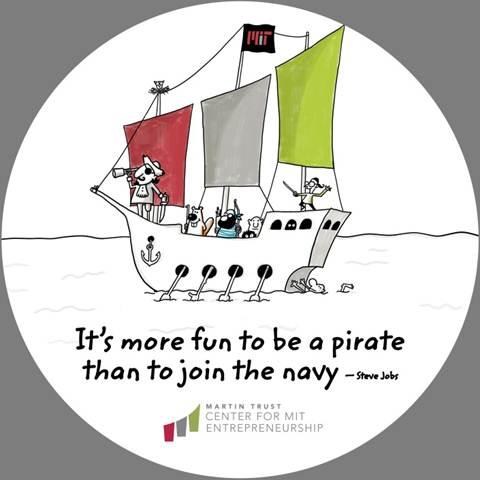
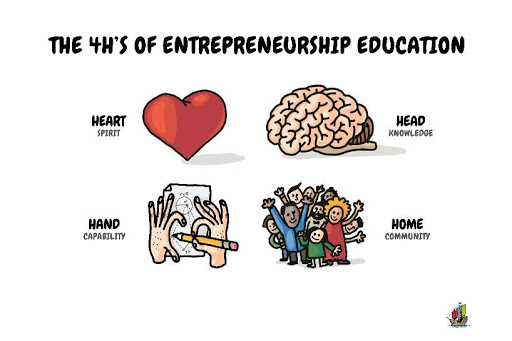
- Spirit of a pirate. Entrepreneurship is all about doing something that has never been done or in a way that has not been done before, so entrepreneurs have to be willing to be different and venture into new areas. If all the fish are swimming one way, entrepreneurs must not only be willing to swim in the other direction, they should also enjoy swimming in the other direction. For an entrepreneur, it all starts with the first of our four H’s – Heart. The “spirit of a pirate” includes not just a willingness to be different, but also an understanding of the difficult journey ahead, as well as the belief that success is still possible at the end of this journey — and that it is well worth the effort. In the Martin Trust Center for MIT Entrepreneurship, we live up to the Steve Jobs quote, “It is more fun to be a pirate than to join the navy,” and we even incorporate the spirit of the pirate into our center’s logo!
- Implementation skills of a Navy Seal. Once our students understand entrepreneurship and are excited and confident about it, we cannot send them into battle without proper training. That is the essence of our next two H’s, the Head and the Hands. We must teach our students the first principles and knowledge that will optimize their chances of success — this is the “Head.” Some of those principles (consolidated from many sources) are documented in the Disciplined Entrepreneurship books I have written and we use in our classroom. We then must create projects where students learn by doing, allowing them to translate their knowledge into capability — the “Hands.” This combination of theory and practice is essential because it reinforces and deepens both the theory and the practice. This creates excellence in execution skills that are required to do something that has never been done before with minimal resources.
- Entrepreneurship education is in its infancy. We have to recognize that entrepreneurship education is relatively new compared to other disciplines such as law and medicine, as well as other business areas such as finance, accounting, strategy, and organizational design. As a result, there is not a large, mature, rigorously curated body of knowledge in the field and our knowledge is rapidly evolving. This has created a situation where demand far outstrips the supply of rigorous, high-quality entrepreneurship education. We must avoid filling this gap with less than rigorous “storytelling,” which at times assumes that assembling successful entrepreneurs in front of students so that they can spout platitudes about working hard is sufficient to prepare them for the great challenges of entrepreneurship. Storytelling has a role in fostering spirit within potential entrepreneurs but is not a substitute for teaching rigorous fundamentals. It is also critically important that in such a dynamic evolving field, we as educators stay current with the latest developments.
- Systems thinking is essential. I cringe when I hear simple solutions to entrepreneurship. Entrepreneurship is a complicated multi-faceted challenge which requires a systems thinking approach rather than a linear mindset. We have to constantly look for connections and relationship between the different parts of the system. We also have to understand that there will most likely be a time delay between an action and the full effects of that action. This is daunting when teaching because it makes it difficult to assess the success of any one program. Systems thinking is the only way to create high-quality entrepreneurs we need for the future.
- An open system with a common language is the best way to scale. The collective wisdom of the group is always greater than that of any one individual. Entrepreneurship knowledge will not come from any one person, institution or country. We all have to work together to build a body of knowledge that everyone can contribute to if we really want to create a discipline that is respected by academics, practitioners, and students. We frame our educational approach using the metaphor of a toolbox, and we constantly incorporate tools from many sources if they are appropriate for our students. The new tools are curated and integrated with the existing ones. When new concepts are proven worthy, we can easily incorporate them without throwing out all the previous good work we have done. Instead, we build off what has come before and continually improve each tool and the overall toolbox, and then we share the toolbox with the rest of the entrepreneurship community through books and articles, workshops, and many other ways.
- The 4th H — “Home” — is most often overlooked. The role of community is most often overlooked and not yet well codified into our educational efforts. This is the fourth and final “H” which stands for Home, or the ability to build and be a productive member of vibrant and sustainable communities. The godfather of entrepreneurship studies at Harvard Business School, Professor Howard Stevenson, famously defined entrepreneurship as “the pursuit of opportunity beyond resources controlled” — the key point being entrepreneurs have to be able to creatively marshal resources they do not currently control, including knowledge, networks, and emotional support. Entrepreneurs do not have the luxury of big companies that have considerable resources under one roof. Entrepreneurs have to be efficient and embrace decentralization. They need to have a core set of skills, but build community with other entrepreneurs and partners both to ensure the success of their individual companies, and of the community of entrepreneurs as a whole. Anyone who has worked with me knows my favorite quote, from Rudyard Kipling’s The Jungle Book: “For the strength of the pack is the wolf, and the strength of the wolf is the pack.” Each entrepreneur has to be strong in their own right, but the “pack” makes them so much stronger and they can achieve so much more.
- Have fun when teaching. This point might seem trite, but having a sense of self-deprecating humor and humility is important for entrepreneurs. While entrepreneurs must take the job of creating a business very seriously (it is hard and important work), they can’t take themselves too seriously. Failure is part of the entrepreneurship process and if they take themselves too seriously, not only will they not survive, but their organization won’t either. As instructors, we teach by our actions at least as much as with our words. So when teaching, let’s not take ourselves too seriously, but let us take our responsibility of teaching very, very seriously. Enjoy the good times and teach our students how to celebrate them as a team, because there are always lots of bumps in the road on the entrepreneurial journey, and we all need to keep our spirits up to survive and thrive.
The author
Bill Aulet
A longtime successful entrepreneur, Bill is the Managing Director of the Martin Trust Center for MIT Entrepreneurship and Professor of the Practice at the MIT Sloan School of Management. He is changing the way entrepreneurship is understood, taught, and practiced around the world.
The Disciplined Entrepreneurship Toolbox
Stay ahead by using the 24 steps together with your team, mentors, and investors.
The books
This methodology with 24 steps and 15 tactics was created at MIT to help you translate your technology or idea into innovative new products. The books were designed for first-time and repeat entrepreneurs so that they can build great ventures.
Bill Aulet on book launch tour in Luxembourg, France and Italy (March 16–27, 2019)
Bill Aulet is visiting Europe this spring to launch the new editions of the Disciplined Entrepreneurship books in French and Italian. Here is where you can catch him (if you can):
Luxembourg
- March 16–17, 2019
Two-day “Introduction to Disciplined Entrepreneurship” workshop for University of Luxembourg (closed event). - March 18, 2019
Book launch event at the University of Luxembourg.
Paris
- March 20, 2019, 19:00–21:00
Entrepreneurship Masterclass @ SciencePo (public event, more details). - March 21, 2019, 17:30–18:30
Keynote @ Station F (public event, register here). - March 22, 2019, 8:30–10:00
The challenge of entrepreneurship & innovation in large corporates @ TownHall AXA (public event, register here) - March 22, 2018, 12:00–14:00
Event @ The Family Incubator (public event, register here).
Rome
- March 25, 2019, 15:00–17:30
Meetup with Bill Aulet @ Manageritalia (public event, register here).
Milan
- March 25, 2019, 18:00–20:30
Workshop and book launch in Talent Gard (public event, register here).
Bologna
- March 27, 2019, 18:00–20:00
Innovation Talks @ Bologna Business School (register here).
The author
Bill Aulet
A longtime successful entrepreneur, Bill is the Managing Director of the Martin Trust Center for MIT Entrepreneurship and Professor of the Practice at the MIT Sloan School of Management. He is changing the way entrepreneurship is understood, taught, and practiced around the world.
The New Mathematics of Startup Valuation
Republished from the Wall Street Journal.
Valuing a company is always a mix of science and art, especially for startups. Historically the science has been pretty simple: Find comparable companies and do a multiple of earnings or revenue.
However, three drivers of startup valuation have emerged that are changing the game. “Acquihire,” is the act of buying out a company for the skills and expertise of its staff. It has become so well-known that it is even listed in the Oxford English Dictionary. When Facebook buys a company like Hot Potato, it’s not for the revenue stream or products — it’s for the employees.
Companies like Facebook and Google have led the way in making acquihire-based valuation more predictable and scientific. But two new groups of acquisitions are more interesting. I categorize them as “efficient customer acquisition” and “buying an option.” They have left traditionalists and “acquihirists” scratching their heads, trying to figure out where these valuations are coming from. But the more we look at these categories, the more they start to make sense.
“Efficient customer acquisition” comes from the new unit economics that entrepreneurs have to understand to be successful: the cost of customer acquisition (COCA) and the lifetime value of an acquired customer (LTV). Acquiring customers is expensive — if you can use completely automated techniques as LinkedIn does, it can cost $10 a customer or less; if you need to deploy high-priced salespeople, it can cost thousands of dollars.
A high COCA is not necessarily bad, nor is a low one necessarily good because your LTV — the profits you expect to make from each new customer has to be taken into account. A customer could be worth $10, $10,000, or $10 million depending on your business.
The LTV-to-COCA ratio is the key metric, as I explain in my book, “Disciplined Entrepreneurship”. For your business to have good fundamentals, your LTV should be at least three times higher than your COCA — from David Skok’s analysis. When a company like WhatsApp is bought by Facebook for $19 billion despite only having 55 employees and forward-looking revenue of at best $450 million, the LTV-to-COCA ratio is key. WhatsApp had 450 million customers, growing at the rate of 1 million per day. Facebook bought WhatsApp’s customers at $42 each, with an anticipated LTV of over $120.
The “buying an option” is much more difficult to quantify. Dominant companies like IBM didn’t feel threatened by startups and wouldn’t have considered buying an upstart like Microsoft. In hindsight, and with the work of academics like Clayton Christensen, executives know better and seek out to embrace disruptive innovations. Microsoft, Apple, Google, and Facebook were the disruptors not too long ago, so it is fresh in their minds.
Acquirers are buying options on an uncertain future with acquisitions like Instagram photosharing, Oculus virtual reality, Boston Dynamics mobile robotics, Titan Aerospace drones, and NestLabs behavioral economics. These companies may or may not pan out. They can win big like Google did with Android and Facebook did with Instagram. But more likely, they will be not very impressive, like Dodgeball or DailyDeal where the acquirers likely overpaid.
How does one value an option like this? That is a hard problem that won three academics (two from MIT) a Nobel Prize for it in 1997 and forever changed economic valuations. People came to realize that an option on something that could be very valuable, even if it had a high chance of being worth nothing, was still very valuable.
With all that in mind, I always end my classes on valuation by saying, “Now that we have done the math, how is the price set? It is very simple: Price is set when willing buyer meets willing seller.” There are a lot of willing, loaded and smart buyers today, so this new math of startups explains why the big companies have not lost their minds and are, in fact, acting very rationally.
The author
Bill Aulet
A longtime successful entrepreneur, Bill is the Managing Director of the Martin Trust Center for MIT Entrepreneurship and Professor of the Practice at the MIT Sloan School of Management. He is changing the way entrepreneurship is understood, taught, and practiced around the world.
The Disciplined Entrepreneurship Toolbox
Stay ahead by using the 24 steps together with your team, mentors, and investors.
The books
This methodology with 24 steps and 15 tactics was created at MIT to help you translate your technology or idea into innovative new products. The books were designed for first-time and repeat entrepreneurs so that they can build great ventures.
Jeff Bezos's Initial Focus on Books Constitutes the Greatest Execution of a Beachhead Market Strategy Ever
Republished from Entrepreneur.com
Emerging entrepreneurs can learn valuable lessons from Bezos’s approach.
Jeff Bezos recently briefly overtook Bill Gates to become the richest man in America. It’s a reminder, much like Amazon’s most recent $13.7-billion acquisition of Whole Foods, of the remarkable power of the company that Bezos has created and the straightforward strategy he used to create his empire. Now, with each new click and each new transaction, Amazon grows its war chest of consumer and market data and the company’s growth appears — at least for the moment — unstoppable.
But it was not always so. Once upon a time, Amazon sold only books. Bezos’s initial focus on books constitutes the greatest execution of a beachhead marketing strategy ever. By creating a narrow and winnable focus for his first product, Bezos was able to build the fundamentals of his company and create a launching pad for Amazon to grow into different markets over time.
Today, when I want to buy audiobooks, gardening tools or a Spike Lee Brooklyn bicycle cap, I shop through Amazon and know it will all be delivered, courtesy of Amazon Prime, to my front door in Boston in two days. I have come to depend on Amazon’s recommendations and customer feedback to guide my purchases. I now have an Amazon TV system and have installed Alexa systems at both home and at work. My publisher directs me to the Amazon author section to see how many copies of my book have been sold each week, and in what regions. And when I relax at the end of the day, I read the Washington Post on my iPad, which is free with Amazon Prime. And it all started with books.
Emerging entrepreneurs can learn valuable lessons from Bezos’s approach. In this case, the book industry provided an ideal beachhead market because it was:
Really simple
In July 1994, the book market was such a simple business that Bezos was able to launch Amazon out of his garage with minimal investment. Books do not spoil, there are no development costs for the product, and products are easy to identify with great certainty as each book has a unique International Standard Book Number. While Amazon’s book business was not growing dramatically, there was consistent demand for the product.
Takeaway: The goal of a beachhead market is to start to generate some revenues, cash flow and potentially even some profits, with the least number of variables possible.
Easy to enter with a high chance of winning
In the 1990s, the sleepy book industry had not utilized technology like other industries. It was simply not a sexy market, and ambitious business people were looking elsewhere for high-growth opportunities. A determined effort by Amazon in the realm of books was much more likely to succeed rather than in the more popular and populated industries such as electronics, food or even pet supplies.
Takeaway: The ideal market has low entry costs. But once in, entrepreneurs can erect barriers, making it harder for others to enter.
Visible but not too visible
The big retailers did not feel Amazon was a threat because, after all, it was only selling books. However, once Amazon built a good reputation with its domination of the book market, it gained the ability to begin attacking additional markets with credibility and on their terms.
Takeaway: You initially want to win in a market that gives your company credibility, but doesn’t go for the heart of the big players’ business, which threatens them and impels them, to react forcefully — which could be the death knell for a fledgling startup.
A safe haven in which to build critical skills to win follow-on markets
In the early 1990s, Bezos determined that the internet was the future and he felt it was going to fundamentally change retail forever. He wanted to be there for this. The beachhead of books gave him a chance to build up a web-based marketplace, interact with customers and then fulfill the orders with an efficient backend operation. These skills were clearly transferrable. If he could perfect them in this simple market, he’d have a competitive advantage when he moved into adjacent and more attractive markets.
Takeaway: A relatively safe haven allows entrepreneurs to develop some fundamental core capability that can be leveraged into adjacent markets where the entrepreneur can reap greater rewards.
Are this business strategy and execution plan unique to Amazon? Not at all. For Apple, it was desktop publishing, which led to it becoming the computer of choice for creatives in their personal and professional lives. For Honda, its expertise around motorcycles led to innovations in engine design for power products such as lawnmowers, a beachhead that it leveraged over time to create luxury cars and now robots.
After brainstorming all the possibilities in a given market, you may find you have limited resources. As a military operation, you are much more likely to succeed if you focus those resources to win one beachhead market and then pick your head up and look for the next adjacent market to win. There’s an old Romanian proverb, The person who chases two rabbits, catches neither.
Bezos learned this lesson well and started with one slow, relatively ignored rabbit. Now he seems to be catching as many rabbits as he wants. The Normandy Invasion of the retail market, and our lives, has happened and it will not be easily stopped.
The author
Bill Aulet
A longtime successful entrepreneur, Bill is the Managing Director of the Martin Trust Center for MIT Entrepreneurship and Professor of the Practice at the MIT Sloan School of Management. He is changing the way entrepreneurship is understood, taught, and practiced around the world.
The Disciplined Entrepreneurship Toolbox
Stay ahead by using the 24 steps together with your team, mentors, and investors.
The books
This methodology with 24 steps and 15 tactics was created at MIT to help you translate your technology or idea into innovative new products. The books were designed for first-time and repeat entrepreneurs so that they can build great ventures.
Entrepreneurship Is a Craft and Here’s Why That’s Important
Republished from MIT Sloan Management Review.
To inspire today’s generation of company builders, entrepreneurship education needs a common language and apprenticeship opportunities.
In my 20-plus years as an entrepreneur and seven years as an entrepreneurship educator, I have explored whether starting successful companies should be thought of as a science or an art. If entrepreneurship is a science, then I could easily teach my students that if they perform actions X and Y, they will get a result of Z. If it is an art, then it can be described no more precisely than as an ambiguous creative process that only a chosen few can pursue as a profitable career.
While I find many elements of entrepreneurship that draw from empirical processes, I also find many others that require creativity. In looking for a mental model that encompasses both requirements in a cohesive model for how to most successfully approach the startup process, I started thinking about potters. These skilled individuals imbue artistry into each pot they throw, but if they don’t have knowledge of the fundamentals of how to mold clay into finished objects, they won’t succeed in their goal. Pottery is neither science nor art. Instead, it’s a craft — a process that draws from both.

There are a few key characteristics of pottery that firmly plants it into the realm of craft, rather than being either an art or science:
It’s accessible. Almost anyone can make a pot from clay. It is not something available only to an elite few who are gifted with extraordinary talent.
It’s learnable. Pottery consists of a number of fundamental skills that aren’t obvious without being taught the particulars of the discipline, but these skills can be taught and learned. Luck alone does not make a potter.
It values unique products. When pottery is done well, it is beautiful and unique. The goal of many pottery craftspeople is not to mass-produce the same item that they or others have created before, but to make something new and valued.
It’s built on fundamental concepts. When a potter is learning how to throw clay on a pottery wheel, there are basic principles such as how to use your fingers and thumbs to mold differently sized grooves and how to perfectly calibrate your foot pedals. While knowing these won’t guarantee success, they can dramatically improve a potter’s odds of understanding more complex concepts later on.
It’s best learned through apprenticeship. For many craftspeople, a crucial part of the education process is apprenticeship. Understanding the full body of knowledge about the craft involves not only using the pottery wheel but other specific skills such as kneading, wedging, and using a kiln. These can be explained via lecture without hands-on practice, but are best learned when combined with apprenticeship-type training.
The author
Bill Aulet
A longtime successful entrepreneur, Bill is the Managing Director of the Martin Trust Center for MIT Entrepreneurship and Professor of the Practice at the MIT Sloan School of Management. He is changing the way entrepreneurship is understood, taught, and practiced around the world.
The Disciplined Entrepreneurship Toolbox
Stay ahead by using the 24 steps together with your team, mentors, and investors.
The books
This methodology with 24 steps and 15 tactics was created at MIT to help you translate your technology or idea into innovative new products. The books were designed for first-time and repeat entrepreneurs so that they can build great ventures.
Effective Manager? Yes. Leader? TBD
Republished from The Boston Globe.
In the fall of 1977, the aspiring Harvard varsity basketball players used to play pickup games every afternoon. All of us were vying for the limited spots on the team. The competition was fierce. I remember one not particularly athletic guy, less of a thoroughbred and more of workhorse, a Clydesdale. I did not see him making the team, but Charlie Baker surprised us. He not only made the team, but turned out to be a terrific teammate.
Governor Baker’s challenges now are much bigger and more significant, but the same attributes he showed back then — a hard worker who knows his limits, a guy who doesn’t take himself too seriously, but is still comfortable being an enforcer when needed — have never left him.
The big question for Massachusetts is whether he can pull off something rarely seen in business and even less often in politics — to be both a great manager and a great leader. To put this in context, managers optimize resources and produce consistent results, and leaders inspire people to effect positive change that is much more than incremental.
On the management side, Baker has taken the reins like a good MBA would, tackling challenges like the MBTA and the opioid crisis with working groups that create logical plans of action for achieving concrete goals. The T doesn’t run well in the winter? Charlie’s Winter Resiliency Plan announced in June will fix certain infrastructure, on a certain timetable, with certain budget funds. A thousand people died from opioid overdoses last year? Charlie’s opioid addiction bill will aim to lower that number by targeting how drugs are prescribed. So as a manager, his reputation as “Mr. Fixit” has proven valid.
The more complicated analysis comes in leadership. The first necessary condition of leadership is to have a clear identity that emanates from core principles. On this front, not only has he articulated core principles, but he has walked the talk. Fiscal conservative, social liberal. Handle problems with a mindset that is moderate, fact-based, tough, and not impaired with political and emotional baggage. He has largely stuck to this approach, with one regrettable exception: his initial opposition to resettling Syrian refugees in Massachusetts, a knee-jerk reaction to the Paris terrorist attacks.
His values tend to be management-centric. The distributed leadership model of the MIT Sloan School of Management is a useful lens to continue the assessment. This framework outlines how effective leaders design organizations to complement their strengths and weaknesses.
This model defines leadership as consisting of both enabling and creative capabilities. The enabling capabilities include making sense of complicated circumstances and building relationships to motivate and sustain change. On the other hand, creative capabilities — developing vision and inventing ways to achieve it — provide focus and energy. The latter are essential for organizations to be truly transformative.
Charlie has shown a great willingness to develop enabling capability in his administration by identifying, recruiting, and retaining top talent regardless of political affiliation. Secretary of Transportation Stephanie Pollack has been a progressive policy advocate for decades; Secretary of Health and Human Services Marylou Sudders is a proud social justice independent; and Chief Legal Counsel Lon Povich advised former governor Deval Patrick on judicial nominees.
The creative capabilities assessment is yet unknown. Vision is what a leader like Martin Luther King Jr., John F. Kennedy, or Ronald Reagan so effectively communicated to us. A vision is an exciting world of what’s possible. It inspires in a much more powerful way than simple competency ever can.
A vision is then-Governor Frank Sargent canceling the destructive highway bypass projects in the 1970s and doubling down on mass transit, including the Red Line’s expansion to Alewife. In his first year, Charlie has yet to offer that compelling vision.
The successful integration of an excellent manager and excellent leader is rarely achieved. It often seems like the two skill sets can’t overlap. That’s not true; it’s just extremely hard to do. The next act for Charlie is to provide that inspiring vision while continuing management excellence. It seems like a real stretch, but based on personal history, I would not bet against the Clydesdale, Charlie Baker.
The author
Bill Aulet
A longtime successful entrepreneur, Bill is the Managing Director of the Martin Trust Center for MIT Entrepreneurship and Professor of the Practice at the MIT Sloan School of Management. He is changing the way entrepreneurship is understood, taught, and practiced around the world.
The Disciplined Entrepreneurship Toolbox
Stay ahead by using the 24 steps together with your team, mentors, and investors.
The books
This methodology with 24 steps and 15 tactics was created at MIT to help you translate your technology or idea into innovative new products. The books were designed for first-time and repeat entrepreneurs so that they can build great ventures.
The Most Overrated Thing In Entrepreneurship
In 2013, I wrote a light piece for Forbes about the “Six Whopping Lies Told About Entrepreneurs” but in hindsight I left out the biggest myth of all about entrepreneurship itself. The single most overrated, and yet common, belief about entrepreneurship is that the idea is paramount.
Yes, an idea is necessary, but it is so much less important than the discipline and process with which the idea is pursued. And, interestingly, all of these are even less important than the quality of the founding team.
The belief that the idea is important becomes invalidated when you work with successful entrepreneurs and begin to see a common pattern emerge: how an original idea morphs and evolves over time as the team does primary market research and starts to focus on customer needs, rather than their initial eureka moment. This observation is borne out in recent research by Professor Matt Marx of MIT, summarized in “Shooting for Startup Success? Take a Detour,” showing that for successful entrepreneurs, the idea they originally started out with is rarely the same as what they ended up succeeding with.

The idea of a better search engine wasn’t novel before Google got started; its value creation was all in the high-quality execution. Similarly, the concept of an electric car was not new when Elon Musk started Tesla, yet it has experienced unprecedented success while others before and since have failed. Likewise for the smartphone and Apple.
I know in my companies, we ended up at much different places than where we thought we would. With one, SensAble Technologies, we thought we were going to be a medical simulation company and we ended up an industrial design company. Another highly visible MIT company, E*Ink, started out focused on digital ink screens for retail outlets, then shifted to low-power cell phone screens, then finally found success with e-readers like Kindle – and now the broad-based market of electronic paper displays. Time and time again, success is not based on the original idea but rather on disciplined execution and the quality of the founding team.
In fact, it is dangerous to become too attached to the original idea and not to the needs and wants of the customer. Too often, the result is that entrepreneurs feel they need to be in “stealth mode” so they can build out their idea before someone can “steal” it.
If you have fundamental intellectual property, this strategy is recommended until you have a chance to patent the key elements of your breakthrough. However, it is then essential to get out and talk with customers, lest you end up like Dean Kamen, who holed up in New Hampshire with his stealth project code-named “Ginger, which also became known as “It.” Enormous hype was built up around “It.” The product, the Segway, finally came out, and as the lackluster consumer adoption demonstrated, “It” would have benefited from a lot more open vetting of the idea and a lot less stealth.
As former student Andy Campanella tells students in our introductory entrepreneurship class at MIT, “If you meet someone in a coffee shop and they can steal your idea and beat you with another company based on your idea from a 15-minute conversation, then you deserve to lose and you did not have very much to begin with.” Or as Dharmesh Shah says, “stealthy is unhealthy.”
In my book, Disciplined Entrepreneurship, I give a framework for a methodical approach to startups that can help guide entrepreneurs through the process of iterating on their ideas, and I look forward to working with students at Strathclyde in the near future on this topic. But to really dive into how to build a strong team and the importance of a unifying culture, I recommend Harvard Business School Professor Noam Wasserman’s seminal book The Founder’s Dilemmas and I would also steer you to a popular article I wrote in TechCrunch titled “Culture Eats Strategy for Breakfast.”
So the next time you listen to an entrepreneur get overly excited about their breakthrough idea, wink at them and tell them that while they need an idea to get started, their focus should be on people and process because in the end, they are what will determine success.
Read the full post on The Strathclyde Business School Blog.
The author
Bill Aulet
A longtime successful entrepreneur, Bill is the Managing Director of the Martin Trust Center for MIT Entrepreneurship and Professor of the Practice at the MIT Sloan School of Management. He is changing the way entrepreneurship is understood, taught, and practiced around the world.
The Disciplined Entrepreneurship Toolbox
Stay ahead by using the 24 steps together with your team, mentors, and investors.
The books
This methodology with 24 steps and 15 tactics was created at MIT to help you translate your technology or idea into innovative new products. The books were designed for first-time and repeat entrepreneurs so that they can build great ventures.